Posts, pics, video and motivation on Travel Lifestyle, countries around the world! Addicted to adventure travel and photography, I'm on a mission to inspire your next journey with entertaining stories, beautiful images, fun travel videos, and useful tips.
A legendary Athenian Riviera resort unfurling across a pine-clad peninsula, Four Seasons Astir Palace brings beach-holiday ease to a culture-rich city trip. Expect private coves, immaculate pools and polished, family-friendly service. Dining options range from Greek specialities at Taverna 37 to Mediterranean cuisine at Michelin-starred Pelagos, while the spa and coastal running routes keep wellness front and centre. It’s the best of both worlds: seaside calm within easy reach of central Athens.
Athens’ grand dame since 1874, Hotel Grande Bretagne pairs palatial interiors with standout service and city-defining views. Rooms and suites feel classic yet fresh, while the GB Spa, with its decadent indoor pool, is a welcome pause between museum hops. For sunset, head to GB Roof Garden where the Acropolis glimmers. With Syntagma Square on your doorstep and the city’s best shopping a short stroll away, this is the timeless choice for a luxe city break.
Tucked between the soaring glass towers and bustling neon-lit avenues of Osaka’s dynamic city centre, the lesser-known precinct of Dojima and its island neighbour Nakanoshima offers an understated antidote to the city’s relentless pace.
Here, riverside promenades and leafy parks slow the city’s frantic rhythm, making space for unhurried discovery of art, culture and history. Yet this oasis of serenity is no backwater.
A tribute to Osaka’s past. Photo: Karen Tee
Those waterways connected the city to the ancient capital of Kyoto via the Yodo River, turning Osaka into a commercial hub of the country. In the 18th century, Dojima was home to Japan’s first rice exchange, a pioneering market that set the tone for modern futures and secured Osaka’s reputation as the nation’s kitchen.
Stroll past galleries while admiring cherry blossom trees and rose gardens, linger at cafés overlooking the water and watch the changing colours of the sky at dusk. These are reminders that even in Japan’s third-largest city, tranquillity and culture can converge.
Art and culture by the water
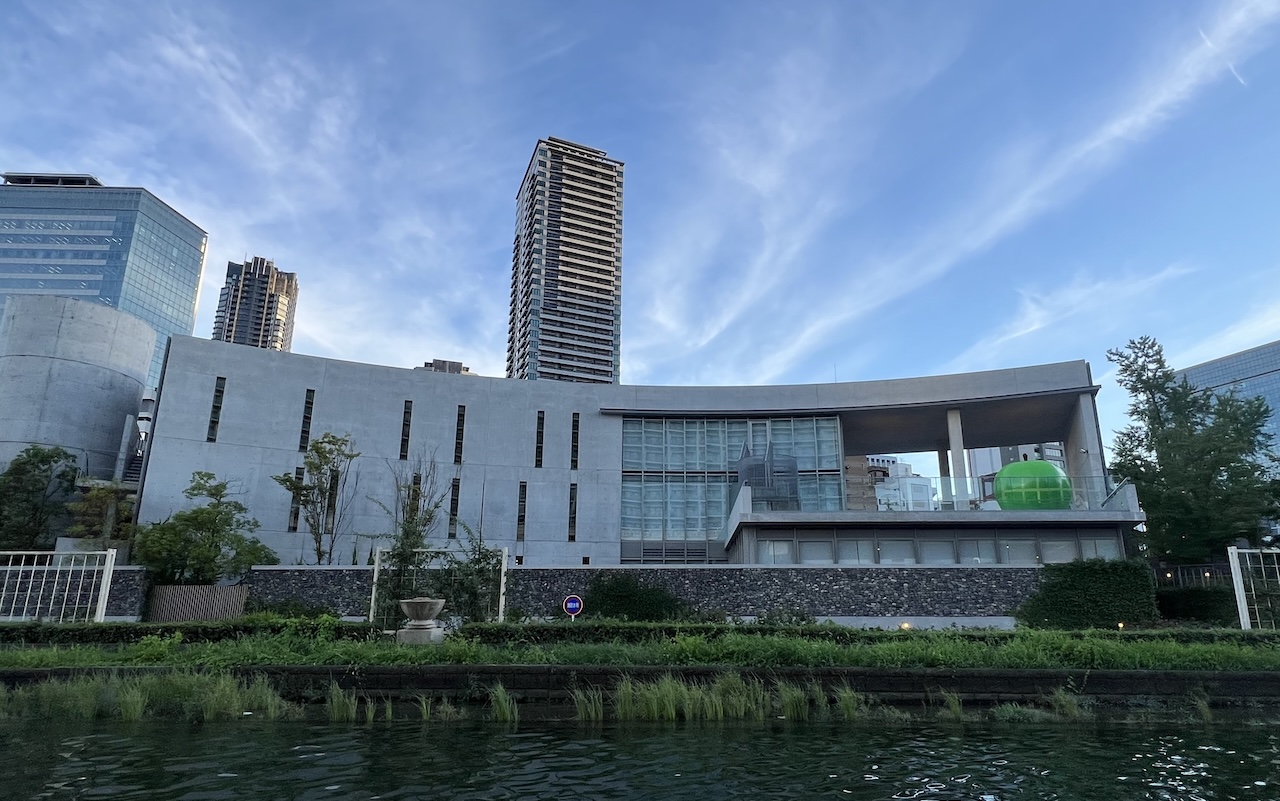
Nakanoshima is often described as the cultural heart of Osaka, and for good reason. The Nakanoshima Museum of Art, a striking black cube that opened in 2022 is more than a photo-stop. Inside, its wide-ranging collection focuses on modern and contemporary art and design from Japan and around the world.
The Nakanoshima Children’s Book Forest is a delightful community space designed by Tadao Ando. Photo: Karen Tee
A short stroll away is the Nakanoshima Children’s Book Forest, a stunning library and community space designed by Osaka-born star architect Tadao Ando. This underrated gem, clad in Ando’s signature cast concrete, is playful and intimate with rows of wooden shelves brimming with picture books that children can browse freely, turning the act of reading into an adventure.
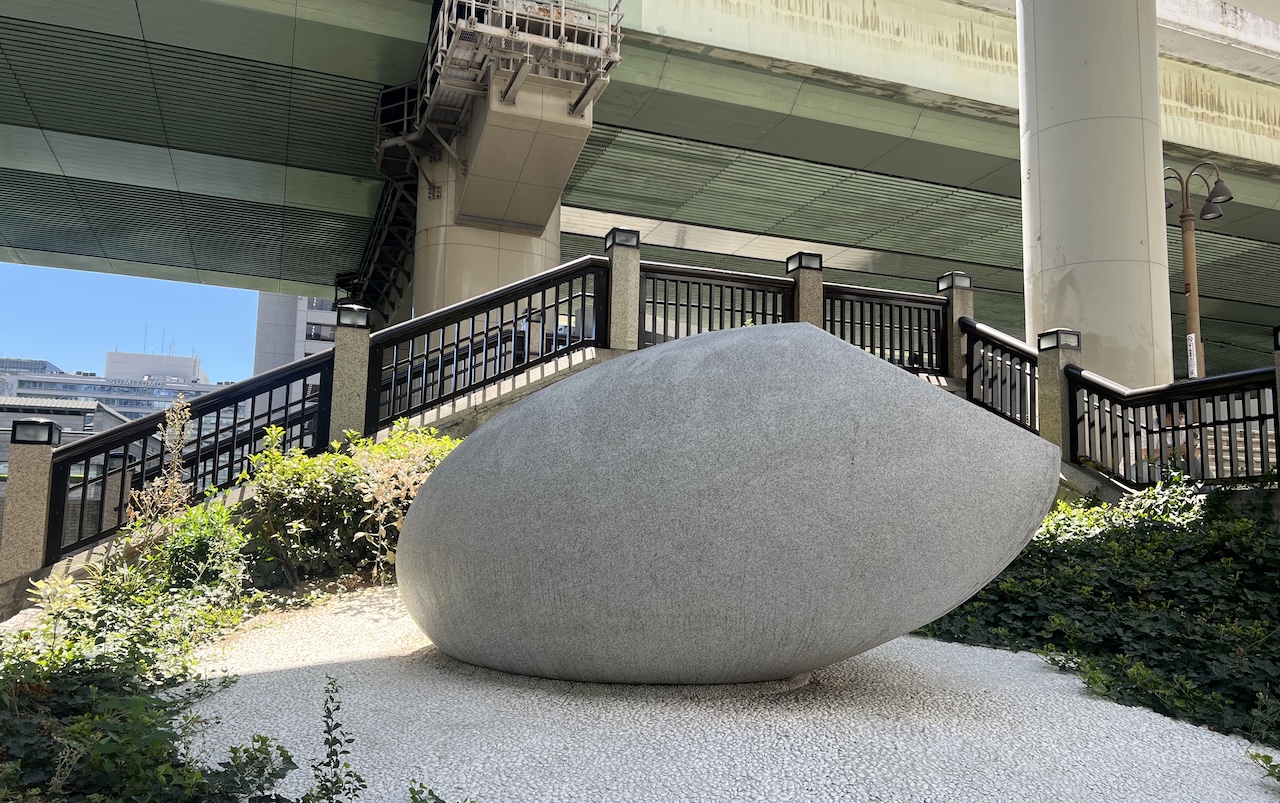
On the Dojima bank of the Nakanoshima Garden Bridge, another Ando creation marks the site of the city’s historic rice exchange. The Dojima Rice Exchange , a giant sculpture of a grain of rice, is a minimalist yet unavoidable reminder of the district’s role in shaping Japan’s modern economy.
Café stops for a breather
There is no better way to soak in the neighbourhood’s riverside rhythm than with a bout of café hopping at independent coffee spots that encourage guests to linger.
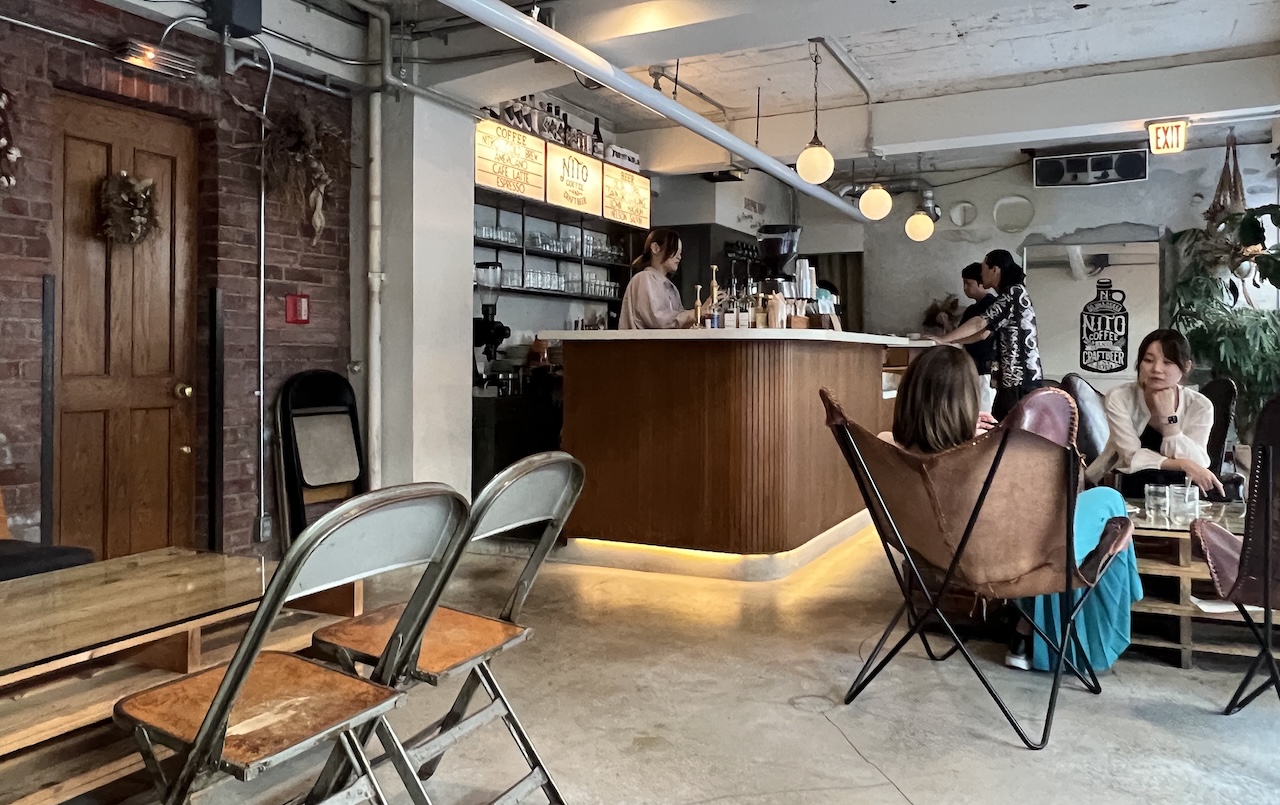
Nito Coffee in Dojima. Photo: Karen Tee
Embankment Coffee is a favourite for its light, flavourful brews and unbeatable view of the Dojima River. Nearby, Glitch Coffee brings Tokyo’s cult roaster energy to Osaka, with single origin beans that draw a steady stream of aficionados. Or for some urban energy, Nito Coffee & Craft Beer is an inviting space to kick back with your beverage of choice.
Luxury living with neighbourhood soul
To feel fully immersed in the rhythms of Dojima, stay at the Four Seasons Hotel Osaka, freshly opened in 2024. It effortlessly blends sleek city style with neighbourhood intimacy and touches of Japanese tradition. A stone’s throw north of the hotel lies the hypermodern Umeda district, Osaka’s transportation and business hub, while in the south, you can easily lose yourself in Dojima’s narrow alleyways, hidden cafés and local eateries.
Experienced refined Japanese living at the Four Seasons Hotel Osaka’s Gensui floor. Photo: Four Seasons Hotel Osaka
The hotel’s standout Gensui floor – billed as a “hotel within a hotel” – offers a modern take on the ryokan experience. Tatami-lined suites, thoughtfully designed bathrooms with a Japanese bath setup and mattresses inspired by traditional futons create a serene, restorative environment. Guests on this floor enjoy an exclusive tea lounge where traditional breakfasts are served and can sample premium local spirits, from carefully curated sake to artisanal whiskeys for a literal taste of Japan.
Hidden food finds in Dojima by day
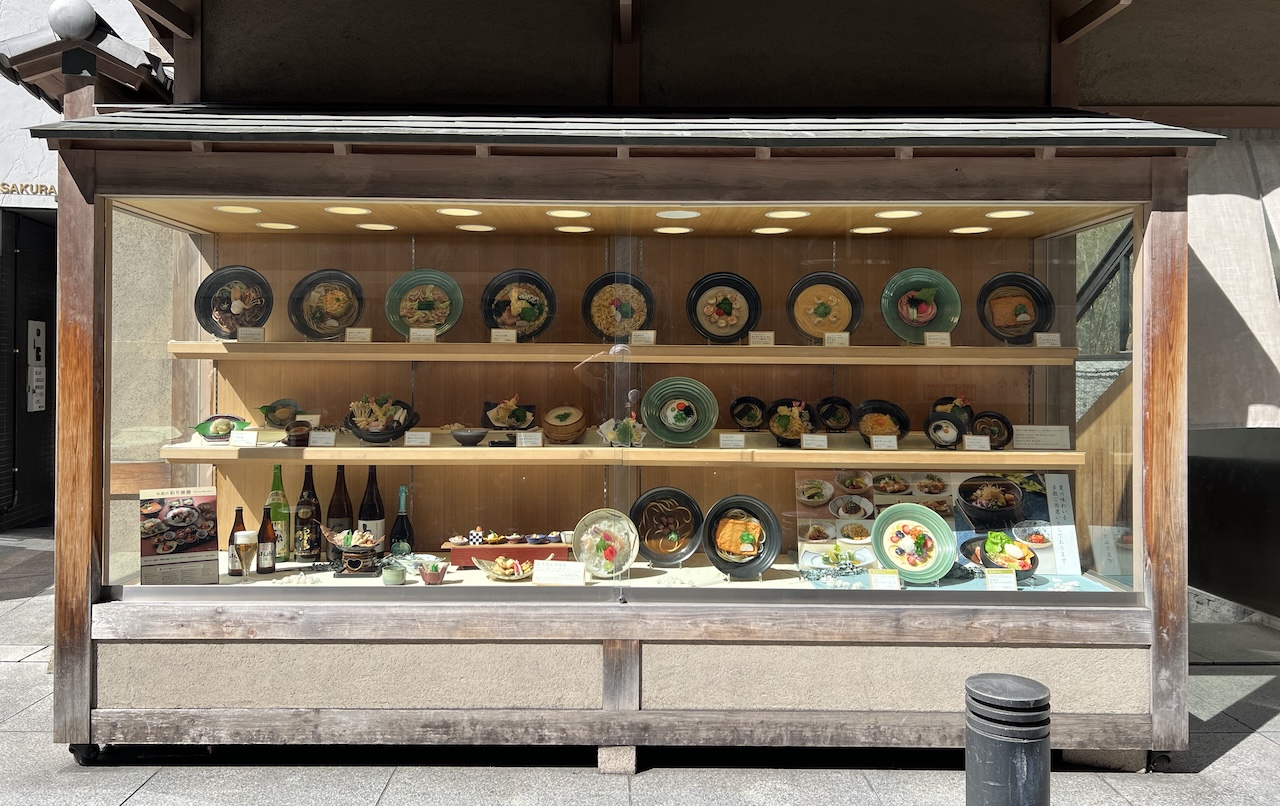
The compact neighbourhood truly comes alive at night, when office workers and locals spill into narrow alleyways in search of hidden izakayas and bars. By day, however, the streets quieten and locals slip into tucked-away eateries or traditional kissaten for a break from the city’s hustle. Wander a little to discover old-school noodle shops and family-run restaurants that have been serving generations, some with interiors largely unchanged since the Showa era.
For example. Nico Cafe’s menu is pared back to just three styles of Japanese curry while the faded wood panelling and vintage décor of Green Peace kissaten evokes a sense of nostalgia for a faded old world. For something heartier, the basement outlet of Tsurutontan Kitashinchi Kinshoro specialises in springy, freshly made udon, served with an extensive array of ingredients.
Tsurutontan Kitashinchi Kinshoro. Photo: Karen Tee
For a culinary treat, the elegant Sushi L’Abysse Osaka is a study in collaboration and contrast. The menu marries the modern French creativity of chef Yannick Alleno, who has 15 Michelin stars to his name, with the disciplined artistry of chef Itaru Yasuda, who has refined his sushi craft over nearly 30 years. The menu begins and ends with Alleno’s inventive starters and desserts, framing a multi-course Japanese omakase whose highlight is the exceptional traditional nigiri sushi, each piece a masterclass in texture and balance that features seasonal flavours.
Vintage finds in a quiet enclave
Umeda is Osaka’s shopping powerhouse, offering everything from luxury department stores to all the major Japanese high-street brands. But for something more distinctive – and to tap into the zeitgeist of secondhand shopping – it takes just ten minutes by train to get to Nakazaki-cho, a bohemian residential enclave known for its vintage boutiques.
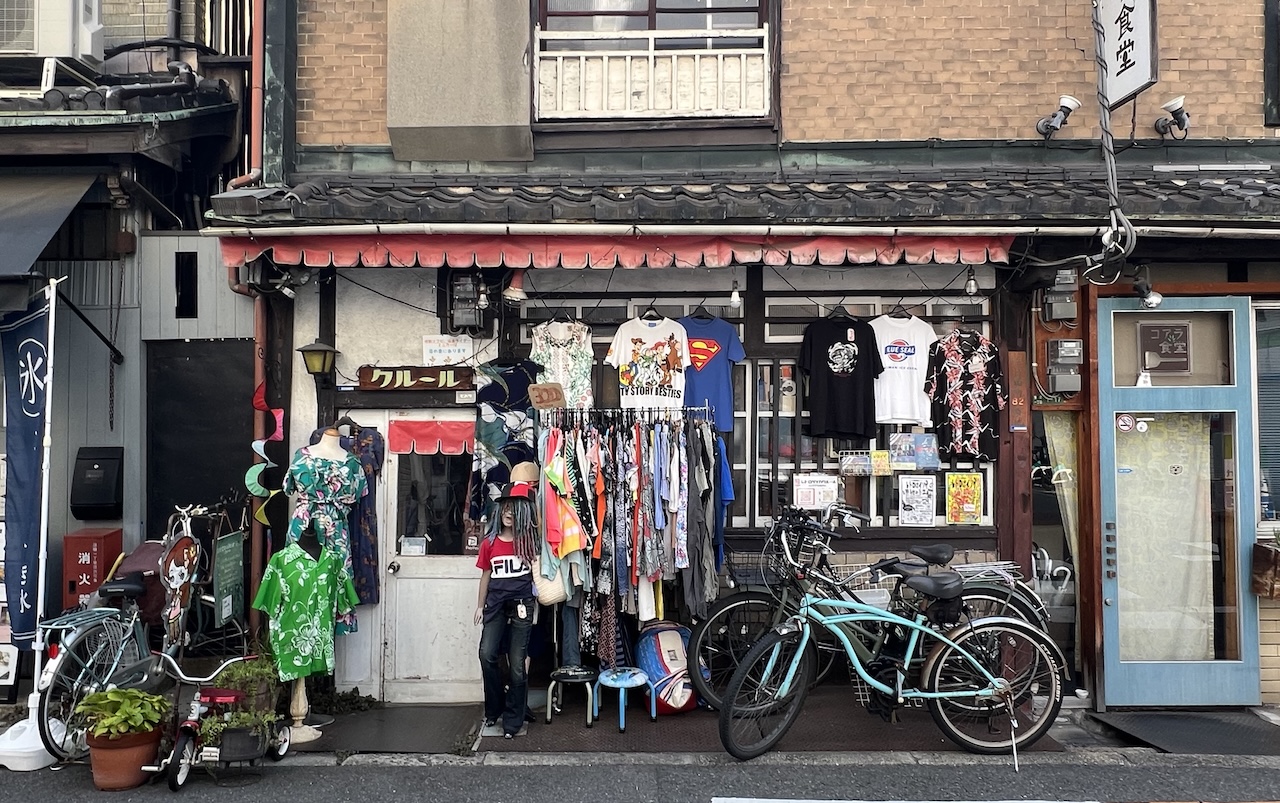
Vintage shop in Nakazaki-cho. Photo: Karen Tee
The small shops offer carefully curated second-hand clothing, retro homeware and one-of-a-kind antiques for treasure hunters. Some interesting stores include Tad Vintage, Cetten and Vivie.
Cruise through the waterways
After a day of wandering by foot, it is time to see Dojima from a different perspective. The neighbourhood’s riverside setting makes it ideal for a leisurely sunset cruise. The Aqua Liner offers regular scheduled rides through the area but for a more personalised experience, the Four Seasons Osaka can arrange a private trip on a converted fishing boat for a scenic cruise between Nakanoshima and Osaka Castle.
An Aqua Liner ship cruises down the river in Osaka. Photo: Shutterstock.com
As the sun sets and bridges begin to glow, drifting along the river offers a serene, almost cinematic view of the city in a perfect finale to an exploration of Osaka’s gentler side.
For more information on Singapore Airlines’ flights to Osaka, visit singaporeair.com.
At the turn of the millennium, Phnom Penh presented a low-lying conurbation that felt chaotic, traffic-choked and run-down; in 2025, it has nearly 2,000 high-rises. As the dazzling Techo Interntional Airport, designed by British firm Foster + Partners opens in September, now’s the optimum time to take in the unstoppable urbanisation and glamorous gentrification of Cambodia’s largest city.
In 2014, Vattanac Capital Tower opened near Phnom Penh’s train station on Monivong Boulevard. Its atypically angular architecture housed a luxury mall, serviced apartmemts, offices and eventually, in 2018, the Rosewood luxury hotel (see below). It marked a turning point in the city’s fortunes; suddenly, skyscrapers shot up, and upscale hotels, cafés, bars and restaurants lined the streets. In 2023, Phnom Penh hosted the South East Asian Games, its largest-ever sporting event, principally at the Morodek Techo Stadium in Chroy Changvar peninsula.
Vattanac Capital Tower was one of the first skyscrapers to be built in Phnom Penh.
The new airport, located 30km outside the capital, connects to central Phnom Penh by a specially-built highway and features lush greenery, rooftop gardens, native flora and natural light. Its terminals are almost entirely powered by solar energy, with the aim of making Techo a sustainable, eco-friendly location. Seductive shopping spots along the way include the huge AEON 3 mall, the largest of three AEON malls, and Chip Mong 271 Mega Mall, the first fully Cambodian-owned mall in Phnom Penh.
Just across the water, a weekend in the capital starts at Sisowath Quay, the riverside boulevard that hosts the Royal Palace and its many constituent buildings – the Silver Pagoda is a standout – as well as a host of marvellous restaurants and bars. From here you can also admire Chroy Changvar, which lies at the confluence of the Mekong, Bassac rivers and Tonlé Sap lake, and now hosts Cambodia’s tallest building – the ultra-luxe condominium Morgan EnMaison, complete with helipad and yachting marina. You’ll also immediately identify Sokha Hotel, an unmissable luxury property opened in 2015, which has hosted dignitaries and world leaders.
The standout Silver Pagoda. Photo: Shutterstock.com
At lunchtime, enjoy the breeze on a remorque (three-wheeled, motorised trailer) to the Phnom Penh outpost of the lauded Cuisine Wat Damnak, a delectable and peaceful dining experience set in a restored 1950s villa with a garden that’s every bit as sophisticated and elegant as its Siem Reap namesake.
Appetites sated, head over to the fascinating SOSORO Museum, which uniquely traces Cambodian history through the lens of economics and politics. The museum’s 12 exhibition rooms take visitors on a 2,000-year journey through displays and multimedia presentations.
Be sure to try a ride on a remorque in Phnom Penh. Photo: Governor of Phnom Penh
Later in the afternoon, by way of contrast, find creative sanctuary atDinArt Gallery. This idiosyncratic exhibition space was founded by artist and former architect Teang Borin, who specialises in abstract paintings of apsaras – female nymphs or fairy spirits – that reflect Khmer culture, religion and society. Then head back towards Sisowath Quay to visit the newest attraction. Walk Street stretches from Phnom Penh Night Market to Chaktomuk Conference Hall, and at sunset becomes a vibrant locale for a weekend evening stroll, with food stalls, street performers – musicians, dancers – and a cool breeze off the river.
Explore Cambodia through its cuisine at the popular Night Market. Photo: Governor of Phnom Penh
Walk Street also hosts a plethora of stalls selling everything from cosmopolitan street food – Cambodian, Chinese, Korean, Japanese – and drinks to souvenirs and handmade goods. Most local vendors now widely accept cashless payment, allowing visitors to pay by scanning a QR code or the Bakong Tourists app. The area intends to introduce Cambodian culture, old and new, to those who may be unfamiliar with it – performances are characterised by traditional dances graced with energetic movement, playful audience interaction and colourful costumes. Visitors can also take a three-wheeled cyclo (aka pedicab) if the walking becomes tiring.
To end the evening, head to Langka Lane, an intimate enclave full of speakeasies, boutiques, izakayas and cosmopolitan resto-bars (French, Vietnamese) – and if you still have the energy, wander down nearby Bassac Lane, one of Asia’s most characterful cocktail alleyways. Once a leafy residential area, this laneway evolved during the mid-2010s into a buzzing nightlife hotspot, and remains a great place to end the night.
Enjoy a refreshing dip after a day of sightseeing. Photo: Hyatt Regency Phnom Penh
Hyatt Regency serves as a fine hotel to stay, an attractive five-star remodelled colonial villa in the city centre offering views of the Royal Palace that’s renowned for its fine gastronomy and rooftop lounge bar serving bespoke cocktails. Its ample outdoor pool, afternoon tea and Metropole Underground, a socialising spot with nightly live entertainment, are further enticements.
A perfect way to start Sunday is to take a guided tuk-tuk journey with Khmer Architecture Tours, which focuses especially on the idiosyncratic buildings of Vann Molyvann, Cambodia’s most influential architect, who pioneered a style known as New Khmer Architecture. In the heyday of the 1960s Molyvann was commissioned by “King Father” Norodom Sihanouk to build several iconic edifices, including the National Olympic Stadium, the Independence Monument and Chaktomuk Conference Hall.
Chaktomuk Conference Hall is an architectural landmark visible on the Khmer Architecture Tours. Photo: Shutterstock.com
Now you can explore Molyvann’s refurbished former home, which has now been transformed into a Brown Coffee (Cambodia’s most revered café chain), mini-museum and shrine to his legacy. Take lunch at the decorative all-day fine-diner Sombok (“nest”), its all-female team masterminded by celebrity chef Kimsan Pol, at the eastern end of Sisowath Quay near the Night Market, which dreams up both Khmer and international concoctions and serves them in impecccable style.
You’ll witness remarkable, eco-forward towers by real-estate pioneers Urban Living Solutions dotted around Phnom Penh – a company bringing new élan to the capital that’s also responsible for Factory, Cambodia’s largest gallery strewn with murals, workshops and co-working spaces.
Inside the Central Market. Photo: Shutterstock.com
In the early evening, head to luxurious hotel Rosewood Phnom Penh for drinks at Sora – a sustainability-forward sky bar which recently became the first Cambodian bar listed on Asia’s Best Bars. Here you can admire the jaw-dropping panorama, which takes in the historic art-deco Central Market (1937) and Royal Railway Station (1932). For dinner, head to Le Manolis, a fun-filled French restaurant and wine bar by the Mekong, and end the night at MAWSIM, the city’s pre-eminent distillery making crafted, spiced gin.
The street-art scene, headed by third-culture muralist FONKi (Fonki Yav), can be seen at his FT Gallery, which specialises in urban contemporary art and even at the Rosewood; and live music is a flourising scene, with blues/rap fusion group Japan Guitar Shop leading the way.
Today, Phnom Penh is Southeast Asia’s fastest-growing, most exciting capital, and the evidence is everywhere you look.
On 9 September, 2025, 0900hrs (GMT +8) Singapore Airlines will move its operations from Phnom Penh International Airport (PNH) to Techo International Airpot (KTI). There will be no changes to the flight numbers or scheduled timings for flights operating to and from Phnom Penh.
For more information on Singapore Airlines’ flights to Phnom Penh, visit singaporeair.com.
Follow the stone-lined walkway into this intimate, immersive space where Chef Shyong holds court over the glowing embers of the binchotan grill. The wraparound counter seating means every diner has a front-row seat to the omakase experience, which starts with beautifully fresh sashimi and a melt-in-your-mouth chutoro carpaccio. The tsukune, served with a rich, marigold egg yolk, packs the delightful crunch of cartilage, while the oft-overlooked bonjiri, or chicken tail, is an unctuous tender morsel.
Chef Shyong, former head chef of Shirokane Tori-Tama, masterfully showcases different parts of the Sakura chicken. The skewer of chicken hearts, chef’s choice of innards today, are plump and sweet with a gentle char. Seasonal vegetables, like the yellow zucchini, are seasoned simply to let their natural flavours shine. Round it all off with a crisp, refreshing Koh-Kun whisky highball.
More than 80 per cent of Singapore’s population lives in Housing and Development Board (HDB) flats, making public housing the very fabric of the nation’s urban life. But beyond affordability and efficiency, HDB blocks have also produced some of Singapore’s most distinctive landmarks. Over the decades, architects and planners have experimented with bold forms, communal spaces and eco-friendly innovations that have shaped not just skylines, but also neighbourhood identities.
From circular towers and sweeping banana-shaped curves to futuristic sky gardens that beat Marina Bay Sands to the punch, these six estates show how HDB design has evolved – and how it continues to blur the line between necessity and imagination.
1. Tampines Street 45: The iconic “gateway” blocks
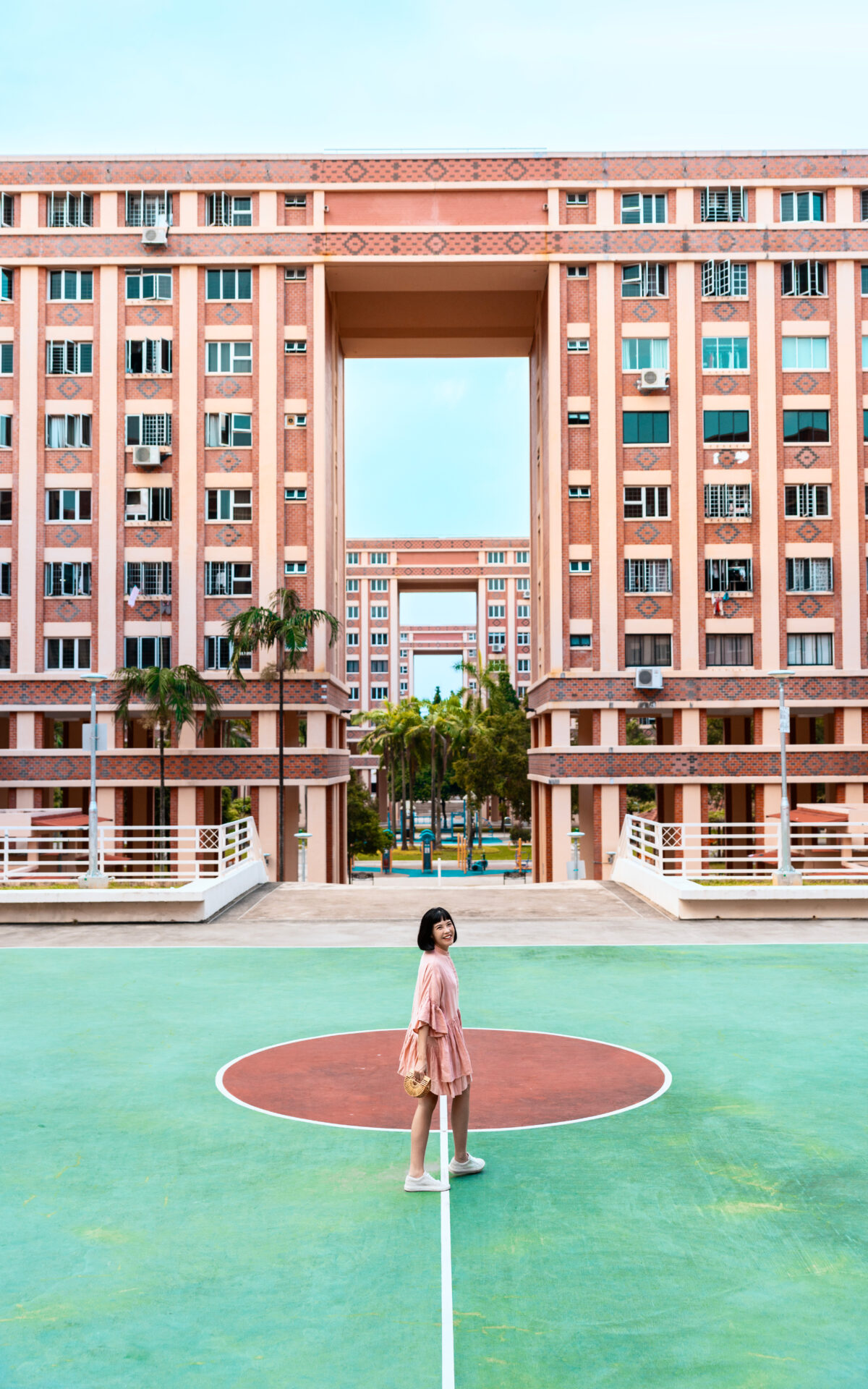
Built in the late 1980s, these pink-and-orange façade blocks in Tampines are instantly recognisable for their monumental rectangular “gateways”. Designed as part of Singapore’s second new town, Tampines, the blocks frame a series of landscaped courtyards and open plazas, creating a sense of rhythm and scale unusual in public housing. Their symmetry and monumental arches give them a grandeur that feels almost ceremonial – a striking example of how HDB once experimented with postmodern forms.
Visit Tampines St 45 to see these iconic HDBs.
2. Pinnacle@Duxton: The condo-style public housing
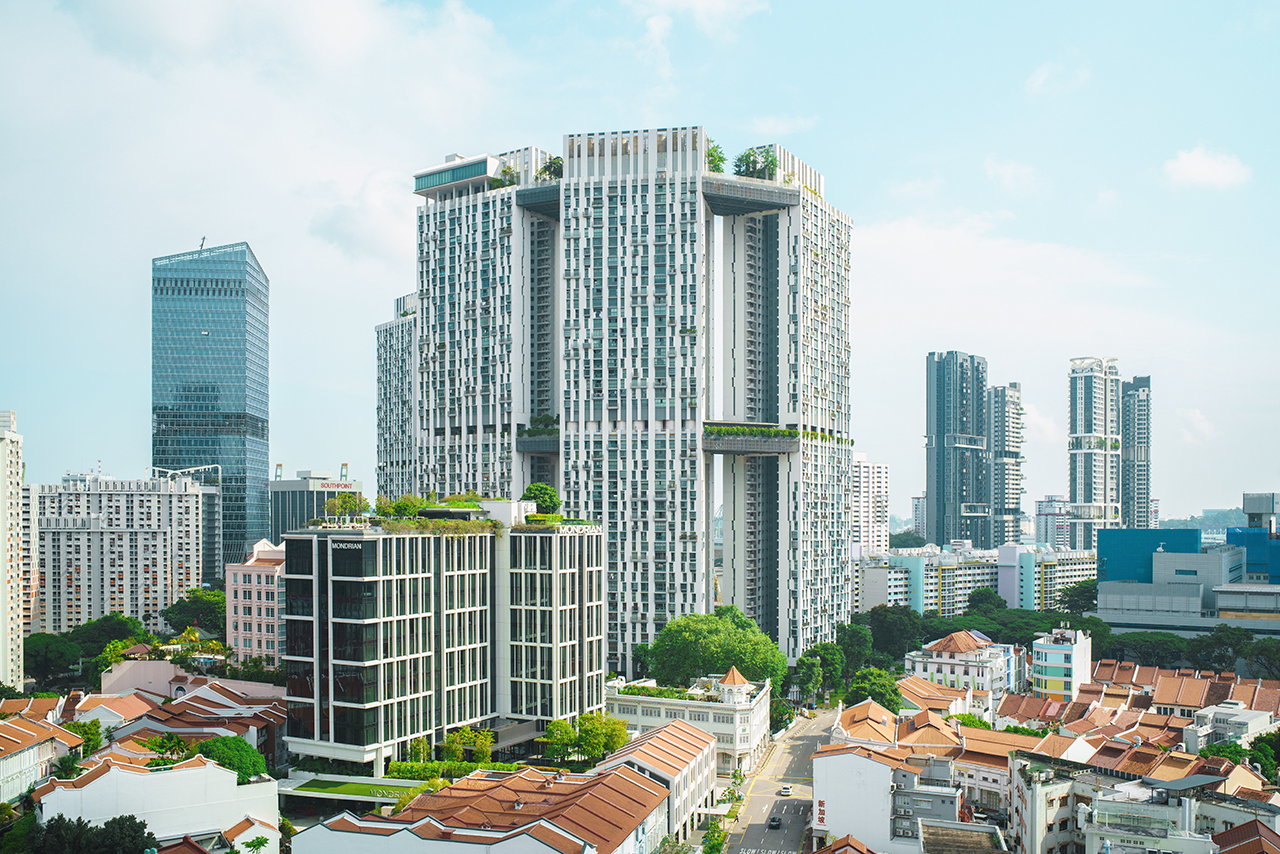
Completed in 2009, Pinnacle@Duxton is Singapore’s tallest public housing project and one of the most famous worldwide. Designed by ARC Studio Architecture + Urbanism with RSP Architects, the seven 50-storey towers are linked by two continuous sky gardens – one at the 26th floor and another at the 50th – stretching a total of 500m each. The project won multiple international awards and symbolised a new era of design excellence for HDB, showing that public housing could also be aspirational, innovative and globally recognised. Fun fact: Pinnacle@Duxton was completed a few months before the Marina Bay Sands opened its iconic towers – a quiet but proud reminder that even public housing was pushing architectural boundaries ahead of Singapore’s most glamorous landmark.
At the time of its opening, Pinnacle @ Duxton’s two sky gardens were an innovative architectural inclusion.
3. Punggol Waterway Terraces: The rice terrace-inspired estate
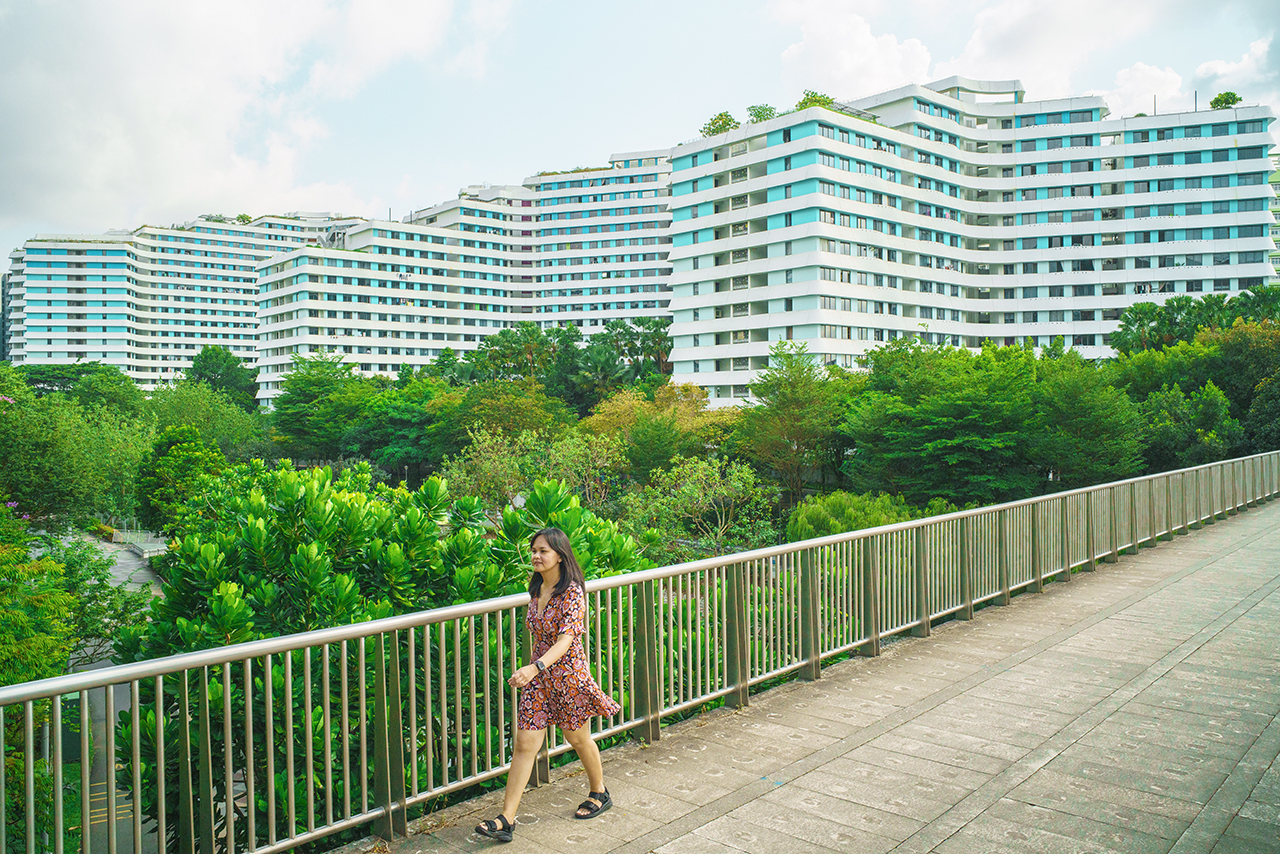
Completed in 2015, these distinctive blocks resemble terraced rice fields, cascading in layers along the Punggol Waterway. Designed by G8A Architecture & Urban Planning + Aedas, the project integrates lush greenery, natural ventilation and rainwater harvesting into its design. The sweeping curves and stepped profiles allow nearly every unit to enjoy views of the waterway, while roof gardens and courtyards create communal green spaces. The terraces embody Singapore’s vision of eco-friendly housing in its youngest new town.
The rice terrace-inspired blocks of Punggol Waterway.
4. Potong Pasir Ave 3: The sloping-roof blocks
Built in the mid-1980s, the iconic sloping roofs of Potong Pasir’s HDBs make the estate one of the most visually distinctive in Singapore. Block 142, emblazoned with a welcoming sign, has become symbolic of the neighbourhood itself. The pitched roofline was part of a unique experiment to break away from the monotony of slab blocks and to give Potong Pasir a distinct identity. It remains one of the most photographed and nostalgic estates in Singapore.
Eighties-styled architecture that has stood the test of time.
5. 34 Whampoa West: The curved “Banana Block”
Constructed in 1972, Block 34 Whampoa West is affectionately known as the “Banana Block” for its distinctive concave curve. At 19 storeys high, it was one of the tallest public housing blocks of its era, built as part of the Housing and Urban Development Company (HUDC) projects. The sweeping arc design maximises airflow and provides residents with panoramic views — a bold move at the time, showcasing early experimentation in form before HDB standardisation took hold.
The creative design of the curved “Banana Block” came before HDB standardisation took root.
6. The Clover @ Kebun Baru: The circular HDB
Built in 1981, The Clover @ Kebun Baru opposite Bishan Park is Singapore’s only circular HDB block. Designed by the HDB’s in-house team of architects, the block features four cylindrical towers joined in a cloverleaf plan. The rounded design created naturally ventilated units with panoramic windows – a refreshing departure from standard slab and point blocks of the time. Though never repeated, it remains a beloved architectural oddity and a reminder of how adventurous HDB once was.
The panoramic windows of The Clover ensured each flat was well ventilated and offered great views of the surrounding areas.
Photography: Mark Teo
For more information on Singapore Airlines’ flights to Singapore, visit singaporeair.com.
From walking through water in Tokyo, to standing amidst crystalline lights in Singapore, the work of digital art collective teamLab has continued to astound audiences around the world with their interactive and powerful pieces. Often questioning the relationship between technology and nature, their work can be seen in the digital flowers at New York’s Grand Central Terminal that grow and die and bloom again, to their night-time teamLab Botanical Garden in Osaka, where art is dependent on the nature and park that it occupies.
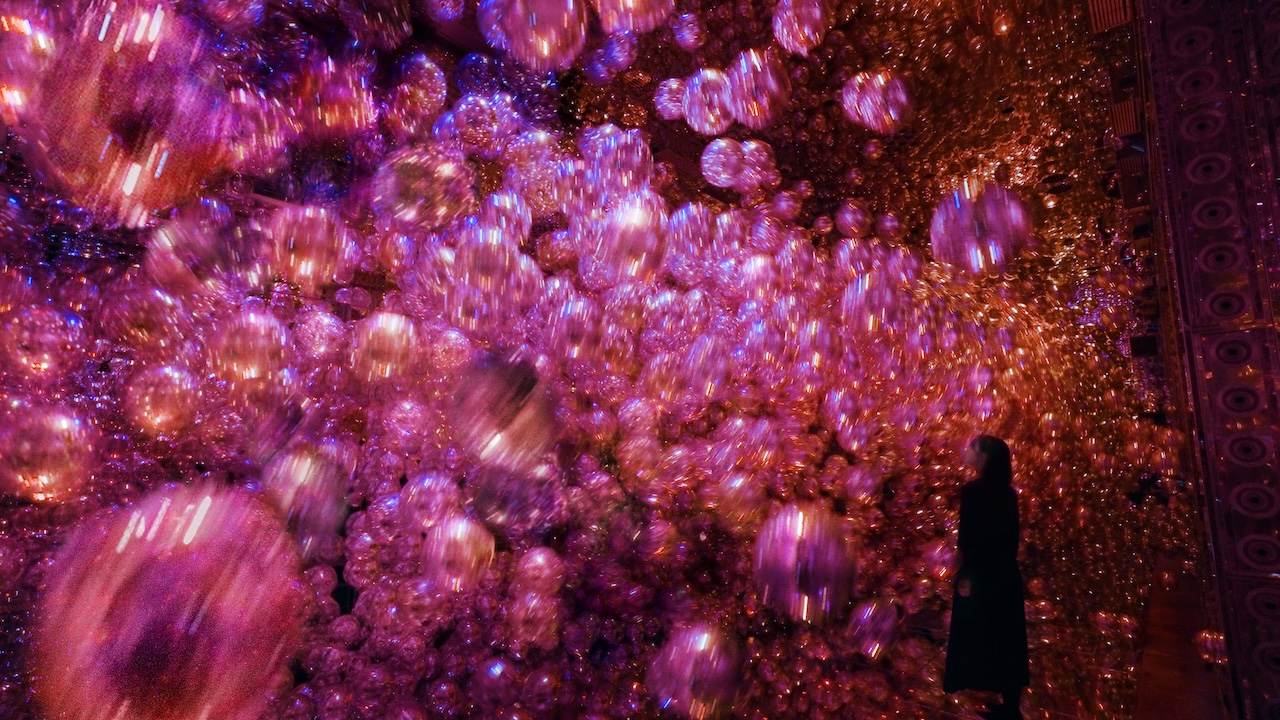
Their latest is set to occupy a creative space in the Kyoto Station Southeast Area Project and is set to be teamLab’s largest museum in Japan. Spanning over 10,000m2, the artwork displayed uses materials not commonly seen in conventional art.
Morphing Continuum is made up of soap, air and water. Photo: teamlab Biovortex Kyoto, Kyoto @ teamlab
Currently six pieces have been announced, some of which have never been exhibited in Japan before. One of them is Massless Amorphous Sculpture, an immense floating piece (currently on view in Abu Dhabi and Miami). Using only soap, water and air, this huge floating foam structure allows people to immerse themselves in it and marvel at how it reconnects and puts itself back together until it is completely destroyed.
Another piece using the same materials is Morphing Continuum, a sculpture with a shape and continuity generated by its environment. It is designed to transcend conventional notions of physical objects and sustain its existence mid-air even when people immerse themselves inside it. Its nature allows it to restore itself even if it breaks.
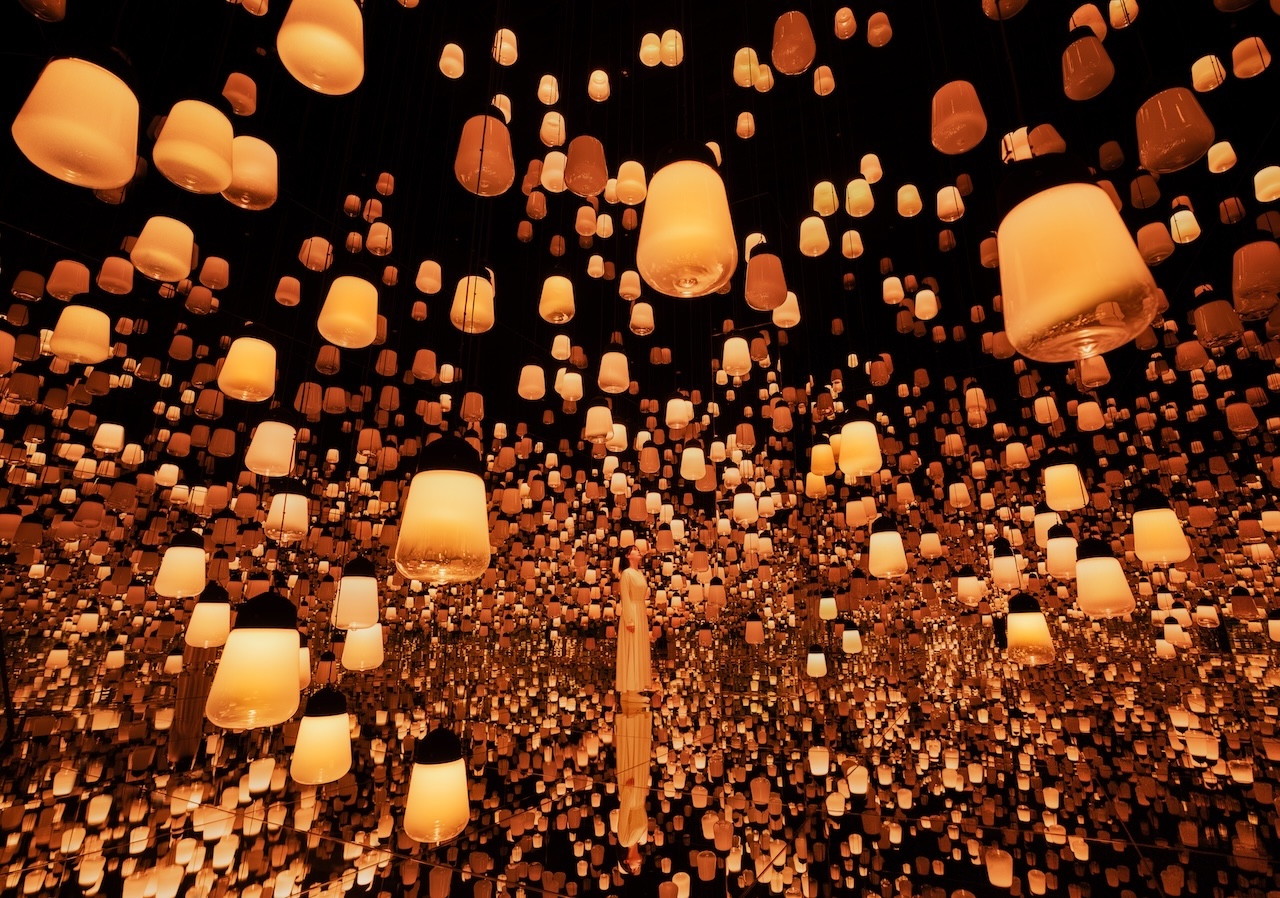
The mesmerising Forest of Resonating Lamps. Photo: teamlab Biovortex Kyoto, Kyoto @ teamlab
Other works include the astounding Forest of Resonating Lamps, previously showcased at teamLab Borderless in Tokyo. While the arrangements of lamps appear to be random, they actually create a single connected path of light from one lamp to another, never intersecting more than once.
Kyoto is an hour and a half from Osaka’s Kansai International Airport and easily reached by car or train. teamlab Biovortex Kyoto is scheduled to open on 7 October 2025, with more installations to be unveiled over time. Tickets are already available here.
For more information on Singapore Airlines’ flights to Osaka, visit singaporeair.com.
After months of chasing cherry blossoms and summer flowers, it’s finally time for fall foliage to have its moment in the spotlight. Often featuring vibrant hues of red, orange and yellow, we love this last burst of colour before the winter months. As the year turns towards prime fall foliage months, we highlight the best places in Asia to visit to witness this change.
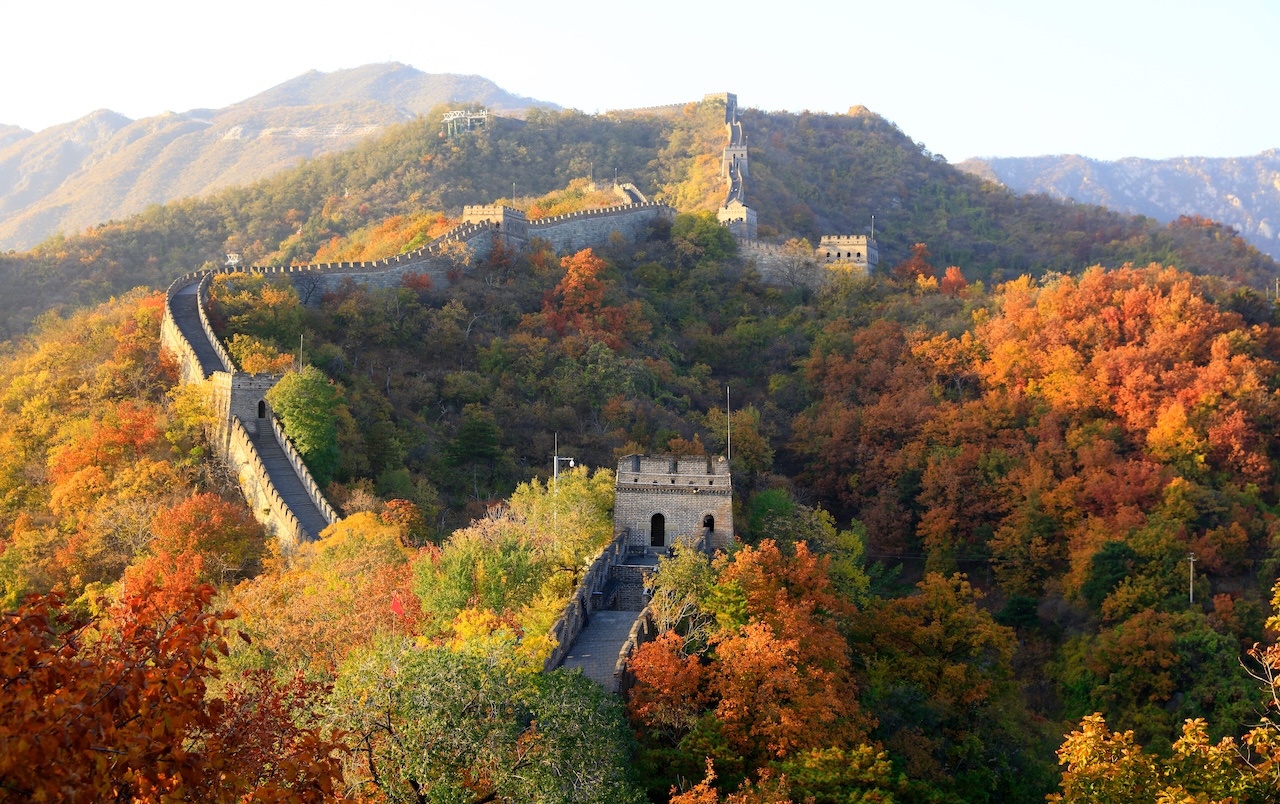
The Great Wall of China is even more stunning during “red leaf season” (typically between mid-October and mid-November), when its surrounding foliage turns a vibrant mix of reds, oranges, yellows and greens. Located just 70km from Beijing, the Mutianyu section is especially popular – active types can head up the Northern Wall Path towards Watchtower 10, then 14 and 20 to reach the highest point of the section before enjoying the cable car ride down from Watchtower 14.
The Great Wall of China in lovely shades of Autumn. Photo: Shutterstock.com
Other popular photo spots include Dajiaolou for panoramic, sweeping views of the wall or from the small platform leading from Zhengguantai to Watchtower 5 that overlooks the colourful mountains and forests.
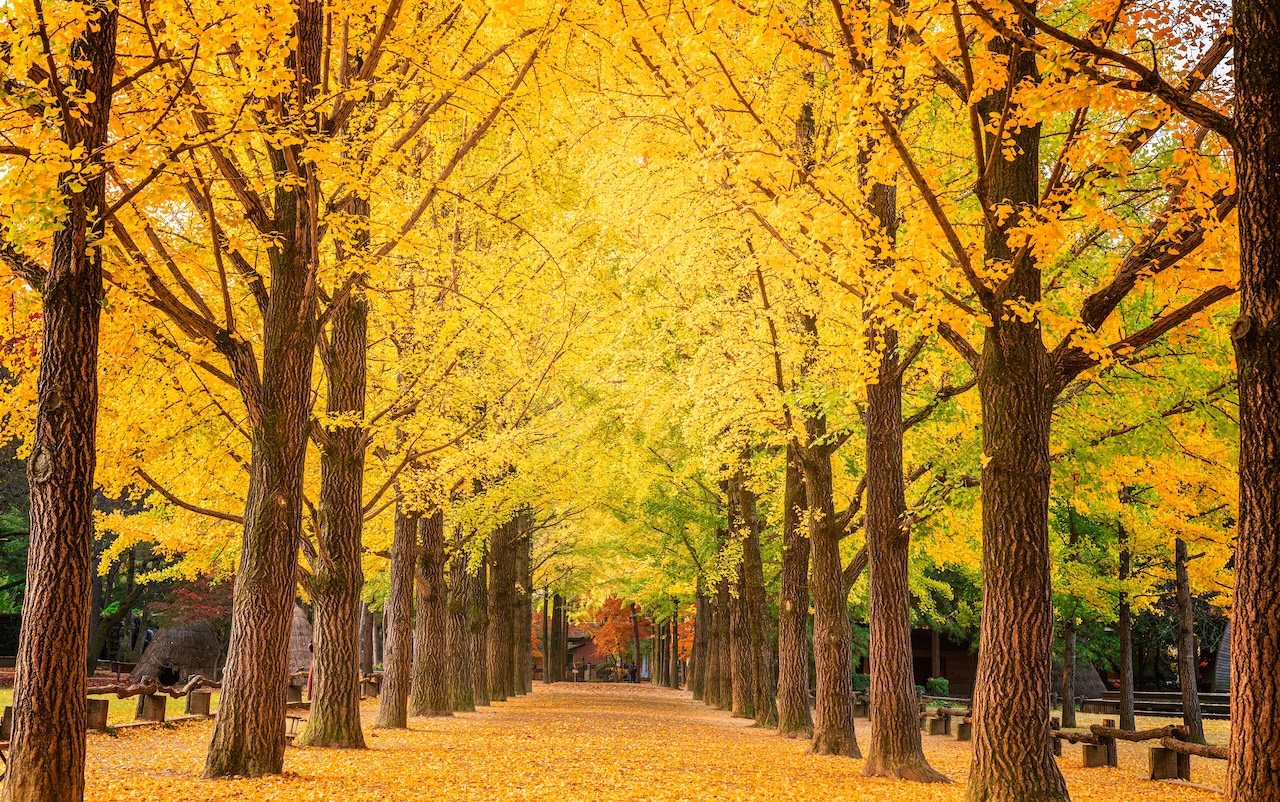
Fans of K-dramas will know and recognise Nami Island for its swoon-worthy scenery, especially after the K-blockbuster “Winter Sonata” was shot here in 2002. The small island in the Bukhangang river is located just two hours away from Seoul, and can be reached by a combination of subway and taxi, or shuttle buses from Hongik University, Myeongdong and Dongdaemun.
Glowing yellow ginkgo leaves on Nami Island. Photo: Shutterstock.com
Float in by ferry or zipline your way in to enjoy the undeniably romantic tree-lined lanes, riverside walks and art installations scattered throughout the 27 thematic gardens and parks. The island is also home to rabbits, peacocks and even ostriches – but beware, they may not be as lovey-dovey.
The inspiration for famous Chinese poets, scholars and artists since the 9th century, Hangzhou’s West Lake – with its picturesque bridges, causeways, pagodas and ponds – becomes even more alluring in autumn, when the air is crisp and mist rises from the lake surrounded by orange maple trees, green pines and cypresses.
Historical landmarks against a background of beautiful colours await at West Lake. Photo: Shutterstock.com
A full loop around the lake is 11.1km and takes around 2.5 hours by foot, but don’t worry, you can always hop on a sightseeing bus, rent a bicycle or take a cruise around the lake to mix things up. Getting to Hangzhou is an easy high-speed train from Shanghai, which takes only 45 minutes to one hour.
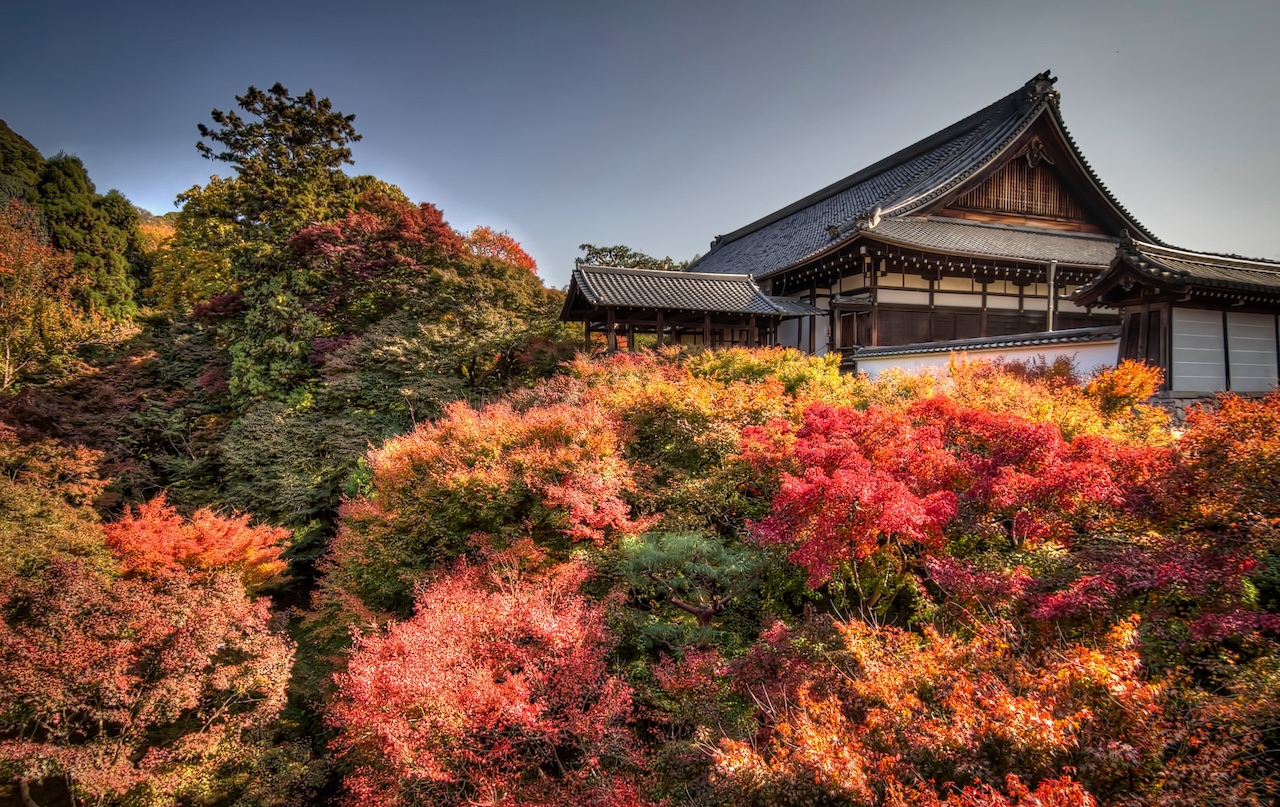
Founded in 1236 by the Fujiwara clan, Tofuku-ji Temple has been one of the largest and most important Kyoto Zen temples throughout history. It’s also one of the most popular spots to admire Kyoto’s autumn foliage in mid- to late-November each year, thanks to the lush maple trees surrounding it turning brilliant shades of red. One of the temple’s top viewing spots is Tsutenkyo Bridge, a covered wooden bridge that connects the main hall and the Kaisando-Hall that spans a valley of around 2,000 maple trees.
Vibrant colours at Tofuku-ji Temple. Photo: Shutterstock.com
Looking down upon the Sengyokukan Gorge, the scenery is so unreal and heavenly that it’s been likened to a sea of clouds. Taking the Shinkansen from Osaka will get you to Kyoto in just 15 minutes, making it an easy day trip, though spending a few days in the city will truly allow you to soak up the ancient culture.
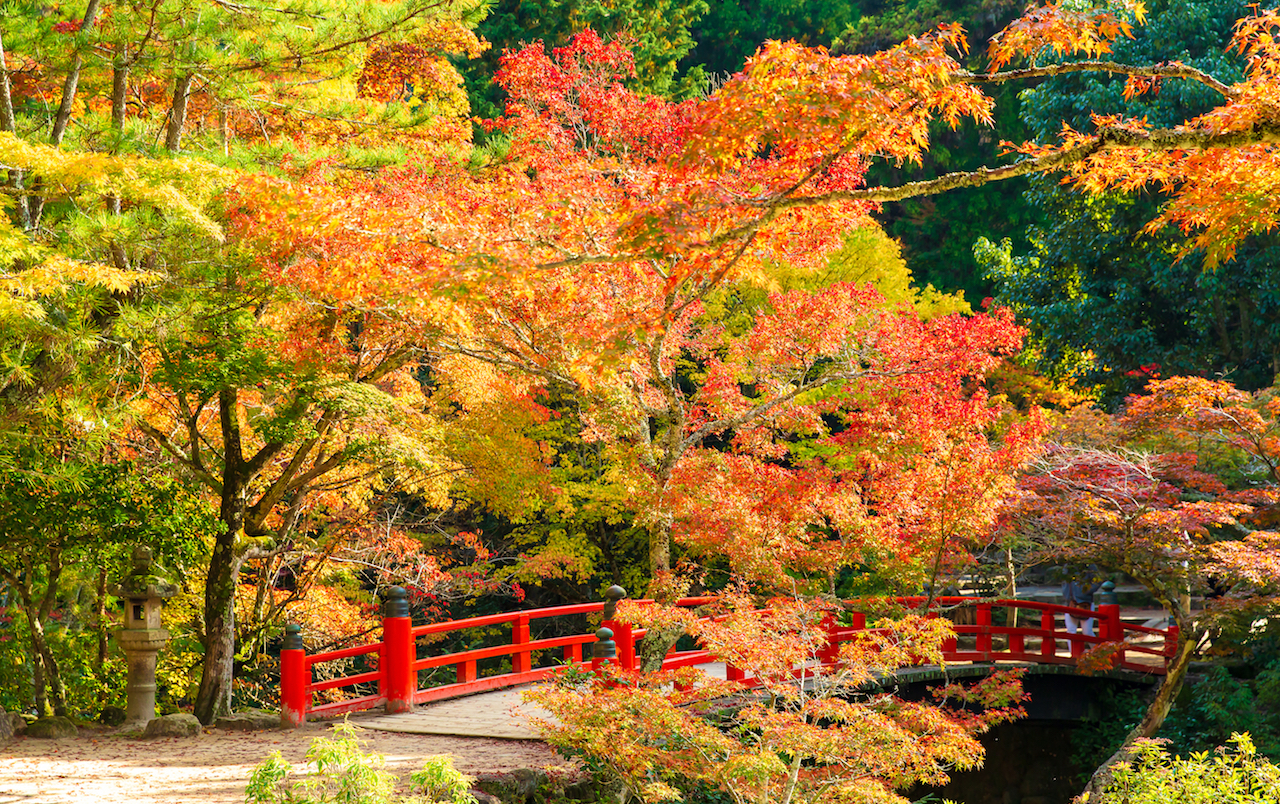
The view atop Miyajima Island’s Mount Misen is spectacular; the fall foliage is seemingly endless and lines the mountain as well as the rest of the island. Although it’s definitely worth the short climb, there’s also an option to take a cable car up.
The tranquility of Miyajima Island is breathtaking against the colours of Autumn. Photo: Shutterstock.com
After that, find tranquility at Momijidani Park, a maple tree park famous for its namesake; here, tree-lined paths and traditional red bridges lead to picturesque areas perfect for watching the wildlife. Accommodation on the island is limited, so stay in Hiroshima and make a day trip to the island instead via ferry.
Situated between Mount Hehuan and Mount Snow, Fushoushan Farm boasts an impressive view all year long, made particularly spectacular during fall when the Japanese maples turn a brilliant red. Travellers can also visit Heaven’s Pool, famed for being filled with water all year long.
Fushoushan Farm in Taichung, Taiwan. Photo: Shutterstock.com
The farm offers lodging in the form of chalets, or you can do a day-tour from Taipei or Taichung (the drive either way is about three hours long). Be sure to sample the region’s Fushou Everspring Tea, which is highly sought after.
7. Seoul: Naejangsan Mountain, Jeollabuk-do
Located in the Jeolla-do province, Naejangsan is one of the best mountains in Korea for viewing colourful leaves and is popular with both tourists and locals alike. Take a ride on the cable car provides for unparalleled views of the park followed by a walk through the forest which will lead you to waterfalls like the 20 metre Dodeok Falls, and further in, Geumseon Falls, where legend has it, the gods used to bathe.
Naejangsan Mountain, South Korea feature vibrant red leaves. Photo: Shutterstock.com
If fighting the fall foliage crowds sounds daunting, the area is also great for catching the elusive cherry blossoms in the spring. A bus from Seoul takes about three hours to reach the mountain.
This world heritage site attracts visitors year long, but is especially popular during the fall when its leaves transform into gold, red, and orange. Chuzenji Lake was created when Mount Nantai erupted 20,000 years ago and blocked the valley below. Today, visitors can marvel at the lush flora and relax at Chuzenjiko Onsen, a small hotspring town with plenty of ryokan-style accommodation.
Chuzenji Lake is worth the trip out of Tokyo for the vibrancy of the colours. Photo: Shutterstock.com
The period to see the leaves is fairly short; spanning from late October to late November, so book your trip and get your foliage fix in before it’s too late. Trains from Tokyo to Nikko take about two hours.
The trees that line Hoan Kiem Lake give the area in Hanoi an enchanting feel, and when they change in fall, they add a burst of colour to the otherwise serene scenery.
Hoan Kiem Lake is a popular spot for locals and visitors alike. Photo: Shutterstock.com
The lake surrounds Ngoc Son Temple, a pagoda housed on an island in the middle of the water. Arrive early enough and you’ll catch local residents practicing tai chi along the shore.
The picturesque Jiuzhaigou Valley could have been taken out of a fairytale and fall is undoubtedly the best time to go. The valley’s vast expanse features big blue lakes, cascading waterfalls, and lush forests that turn shades of gold, red and even purple during this season.
Don’t miss the contrasting colours of the lakes and leaves at Jiuzhaigou Valley. Photo: Shutterestock.com
A view of these colours beautifully reflected in the picturesque lakes makes the journey and the potential fight with the crowds worth it. From Chengdu, take a bus from Xinnamen Bus Station and be sure to head to the valley (not just the city).
For more information on Singapore Airlines’ flights to the above destinations, visit singaporeair.com.
James Turrell’s art is kind of a rare thing in Southeast Asia. The 82-year-old Los Angeles-born artist – known for works that turn empty spaces into hypnotic fields of colour using mostly just natural light sources – has a habit of working at monumental scales, often in far-flung locations, such as his ongoing Roden Crater project in the middle of the Arizona desert. However, major pieces can also be found in American institutions such as LACMA in Los Angeles, the de Young Museum in San Francisco, the National Gallery of Art in Washington, DC and the Guggenheim in New York. (Deep-pocketed fans like Kim Kardashian and Kendall Jenner have commissioned pieces at home.)
For fans in Singapore and the region, the nearest place to see Turrell’s works is East Asia, though it has been reported that a new work will be unveiled at Dib International Contemporary Art Museum in Bangkok when it opens in December 2025. In the meantime, fans can catch his new works at Pace Gallery in Seoul until 27 September, and three permanent spots in Japan.
Turrell’s first solo in Seoul since 2008 takes over all three floors of Pace’s Itaewon gallery, with five recent installations including a new, site-specific Wedgework.
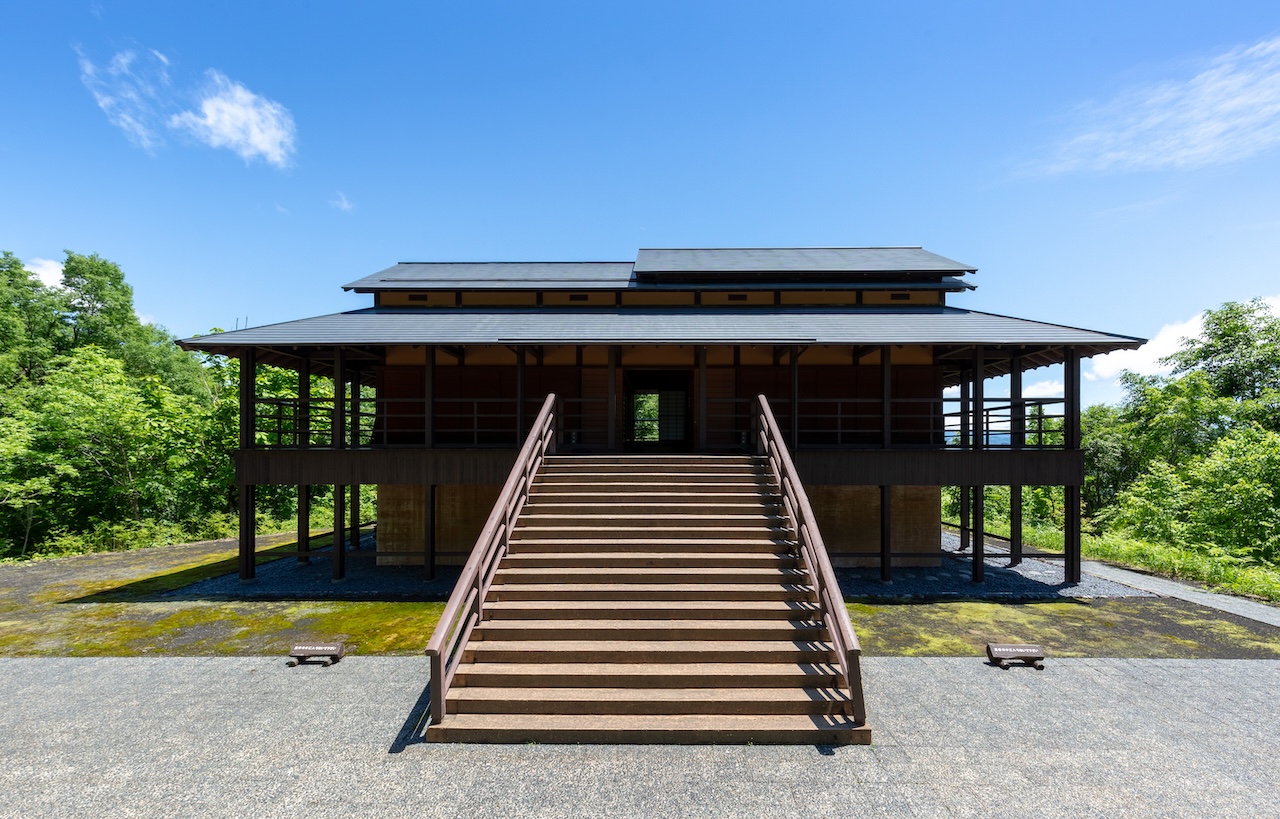
Originally created for the Echigo-Tsumari Art Triennale in 2000, this structure’s ground floor is built of concrete, while the upper level is wooden. The roof opens to frame the sky, filling the tatami-lined interior with shifting natural light.
At sunrise and sunset, the interior lighting changes to emphasise the colours of the sky. House of Light is one of the few Turrell works in Asia that can be booked for an overnight stay. Travel from Tokyo takes about two hours by train.
Tadao Ando’s subterranean museum houses three permanent Turrell works from different stages of his career – Afrum, Pale Blue (1968), Open Field (2000) and Open Sky (2004) – each altering perception in different ways, from a luminous cube hovering in space to a Ganzfeld room that erases depth.
It’s one of the most concentrated encounters with Turrell’s art anywhere in the world. Not to miss: a special sunset viewing for Open Sky. Visiting Naoshima island is easiest from Osaka via Okayama with a combination of Shinkansen and ferry.
Via Osaka: Backside of the Moon in Naoshima
Though part of Naoshima Island’s Art House Project – where artists take empty houses and turn them into works of art – this Turrell work, Backside of the Moon (1999), is actually located inside a custom-built Tadao Ando building called Minamidera.
In this reservation-only experience, visitors are guided into total darkness, where a barely perceptible light field slowly emerges, testing the limits of human sight. No cameras are allowed.
Singapore’s pizza scene has never been this exciting. Over the past three years, a clutch of internationally acclaimed pizzerias – some with century-old lineage, others with Michelin nods – have opened in the Lion City, each bringing its own approach to dough, toppings and tradition. The Little Red Dot is now a hotbed for styles that range from heritage Neapolitan to Japanese-honed hybrids, with chefs chasing precision, provenance and innovation in equal measure.
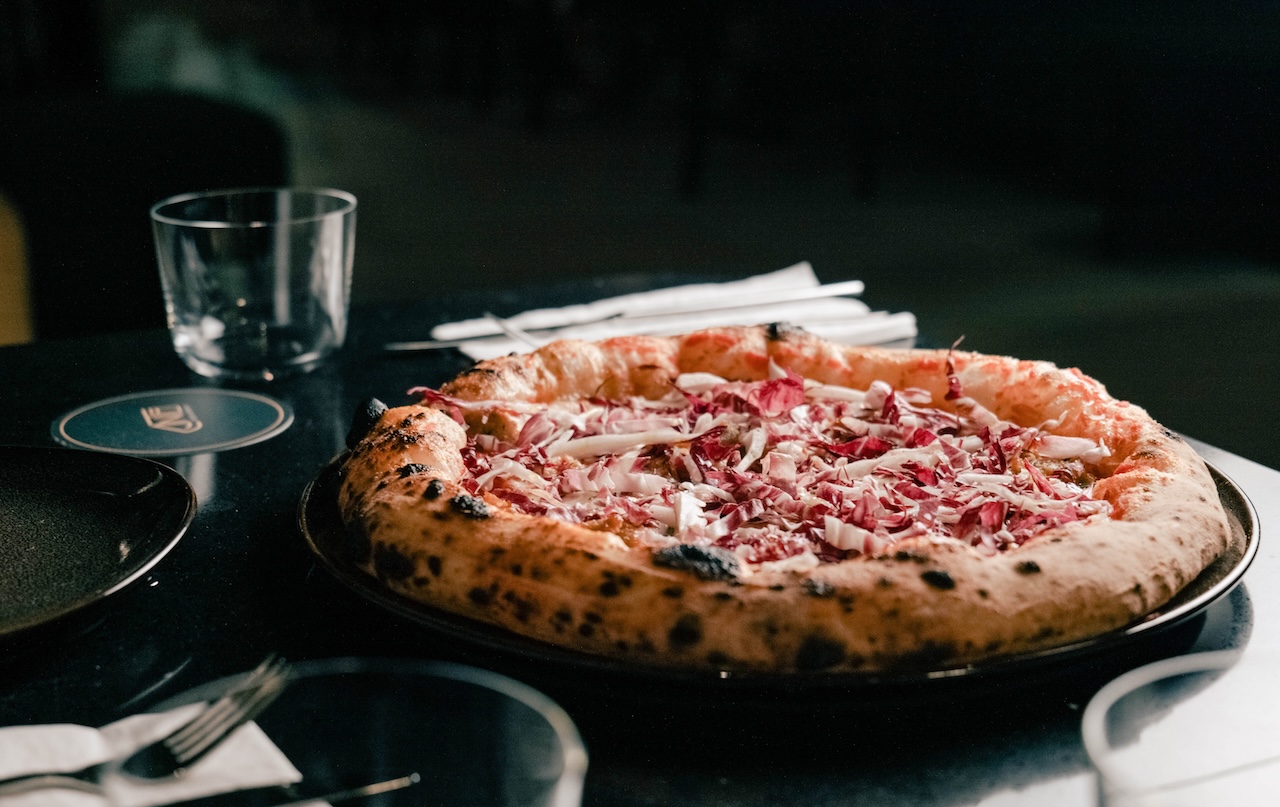
A classic margherita by ANTO. Photo: Anto
“Singapore was a little behind the curve,” says Antonio Miscellaneo, founder of La Bottega Enoteca in Singapore’s Katong neighbourhood. “But it’s catching up fast.” He introduced his “Newpolitan” style in 2018 – a higher-hydration, longer-fermentation dough with more curated toppings – and the city’s appetite for craft has only grown. The result: a pizza renaissance that’s as much about storytelling and technique as it is about taste.
Ranked 15th on the 50 Top Pizza Asia-Pacific list in 2024, La Bottega set the tone for Singapore’s modern pizza movement. Miscellaneo’s Newpolitan approach swaps rigid tradition for innovation without losing soul.
Panzanella is currently Miscellaneo’s favourite pizza on the menu. Photo: La Bottega Enoteca
His panzanella salad pizza –with sweet yellow datterini tomatoes, fresh panzanella and smoked ricotta from his hometown – shows how vegetables can take centre stage. Demand has been so strong that its casual spin-off, Casa Vostra, is opening a second outpost in September, just a year after its debut.
A spontaneous stopover in Singapore in 2022 reignited the long-held dream of three Italian friends – Egon Marzaioli, Giorgio Sorce and Omar Tutino – to open a restaurant together. Fortuna, located in Tanjong Pagar, blends rich dough craft and bold, earthy flavours. The Fried Mortadella Pizza, winner of Asia’s Best Fried Food 2025, layers stracciatella, mortadella, basil pesto and pistachio crumb.
Fortuna loves to explore flavours and textures of a typical pizza. Photo: Fortuna
Even Singapore’s chilli crab gets an Italian reinterpretation here. “The heart of our cuisine lies in a fusion of Neapolitan and Sicilian traditions. Naples brings rich dough techniques and tomato-based simplicity, while Sicily adds bold flavours, earthy notes and inventive combinations,” Marzaioli says.
The Eat, Pray, Love pizzeria still makes its dough the way it did in Naples more than a century ago: resting overnight in a climate-controlled madia, though these days it’s rendered in stainless steel instead of the traditional wooden chest used in Italy. Each night, the dough rests in the middle of the restaurant floor. “It costs me a lot in air-conditioning because I can’t switch it off,” Mazzotta says. “It has to be 22°C.” Ingredients are strictly DOP – Denominazione di Origine Protetta (Protected Designation of Origin ) – such as fior di latte from Agerola, tomatoes from San Marzano.
The pizzas at l’antica Pizzeria Da Michele focus on traditional ingredients and techniques. Photo: l’antica Pizzeria Da Michele
While the Naples flagship serves only two classics, the Singapore outpost on Club Street offers 18 options, including the Cetara, named for the Amalfi Coast anchovies. Pizza lovers in Bangkok also have something to look forward to when it opens its first Thailand outpost at Siam Paragon in October.
Less than a year old, ANTO is already Singapore’s Best Pizzeria (50 Top Pizza Asia-Pacific) and the country’s first to earn a “Golden Ticket” to the global finals in Naples. Master pizzaiolo Antonio Brancato specialises in pizza in teglia – light, pan-baked Roman-style slices. The Melanzana, created for Singapore, features pickled aubergine with vinegar and mint, a nod to his grandmother’s summer ritual.
ANTO’s Rustica pizza features salsiccia fresca and smoked Scamorza cheese. Photo: ANTO
Despite the accolades, the Italian chef is not resting on his laurels. The Armazzo, his latest signature creation under his Le Antonio banner, is an exciting collaboration with two revered brands from Campania, Italy. “It’s a special, highly regional pizza using Cetara anchovies from Armatore and three kinds of tomatoes from Casa Marrazzo.”
Chef Tsubasa Tamaki’s Tokyo-based chain brought its Neapolitan-by-way-of-Japan style to Singapore in May 2025. The dough – a proprietary flour blend milled in Japan – ferments for 30 hours and bakes into a puffed, charred crust dusted with Okinawan salt.
The Tamaki pizza combines Italian tomatoes with Japanese smoked mozzarella. Photo: PST Pizza Studio Tamaki
The Tamaki pizza pairs Italian datterini tomatoes with smoked mozzarella from Japan, while the 5 Formaggi balances richness with a drizzle of acacia honey. Tamaki’s protégé chef Ryosuke Tanahara helms the kitchen in the Tanjong Pagar outpost.
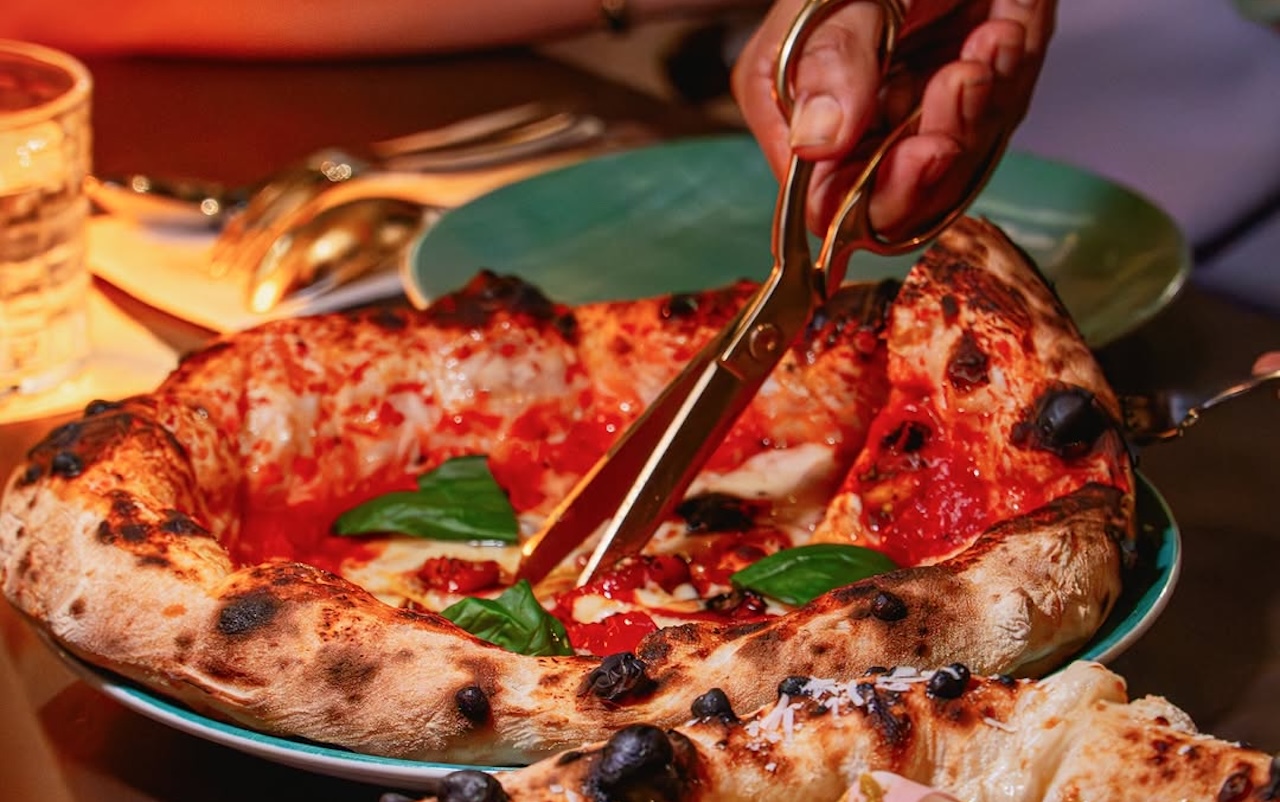
Over at Robertson Quay, pies from the world-famous Vincenzo Capuano are served with a pair of its iconic golden scissors. The concept behind this unusual implement is to preserve the revolutionary airiness of the “cloud pizzas” – traditional pizza cutters would be too heavy-handed on such a light crust.
Golden scissors are used to cut the airy pizzas at Vincent Capuano. Photo: Vincent Capuano
The long-leavened and highly hydrated dough is made with Caputo Nuvola flour, which gives the pizza its signature puffy crust. The Provola e Pepe – smoked provola, crushed tomatoes, roasted cherry tomatoes and basil – won gold at the Pizza World Championship. Pastas hold their own too, like the Guanciale di Manzo with slow-cooked Wagyu cheek ragù and house-made fusilli.
80 Mohamed Sultan Road, #01-12 The Pier at Robertson, Singapore 239013
For more information on Singapore Airlines’ flights to Singapore, visit singaporeair.com.
As a small island nation without natural resources, Singapore’s people are its greatest asset. And Singapore’s creativity and innovation is being recognised globally as these cutting-edge brands and creators have been making waves beyond the little red dot.
1. State Property: dynamic jewellery with modern inspiration
Run by a husband-and-wife team – industrial designer Afazal Imram and award-winning jewellery designer Lin Ruiyin – State Property began in 2015 creating pieces that blend modern, architectural structures into rings, bracelets and necklaces. Their easy-to-wear styles that stand out in a crowd has found global fans like Rihanna, Gigi Hadid and Michelle Obama. Now a decade-old, they can be found at stockists around the world including Dover Street Market in London and at retailers in the Middle East and North America.
State Property’s latest collection is inspired by their three year-old son’s stories. Photo: State Property
Their latest collection which celebrates their 10th anniversary is inspired by a story told by their three-year-old son and the child-like, whimsical wonder that he expresses. The pieces, which feature fun mushroom and egg shapes, as well as rings and bracelets in a distinctive train track, echo the brand’s DNA for blending structure and softness to create jewellery that is resonant rather than trendy.
2. Allies of Skin: powerful science-backed skincare with modest origins
Starting with just one product, Allies of Skin has grown into a globally popular, targeted skincare empire. Founder Nicholas Travis started the brand in 2016, inspired by his own experiences with skin complications and infections resulting from an accident. After two and a half years of research, he confidently launched just three products – the 1A All-Day Mask (a moisturiser with anti-pollution and anti-acne benefits), the Molecular Saviour Probiotics Treatment Mist and the 1A Retinal and Peptides Overnight Mask with a patented, time-release form of retinal. Since then, the brand has gone from strength to strength, with the United States being its biggest market today.
Allies of Skin has grown from three products to a science-based effective range. Photo: Allies of Skin
It is sold in over 36 countries in over 800 stores globally and now offers a wider range of products, with its Multi Peptides & GF Advanced Lifting Serum developing an 11,000 person-long waitlist since it launched in late 2023. Last year the brand secured USD$20 million in investments and is looking to grow its team in the United States.
3. Aupen: the mystery fashion brand loved by celebrities
Aupen first launched modestly in November 2022 but very quickly became the must-have bag when Taylor Swift was spotted carrying the brand’s Nirvana bag in August 2023. It quickly became the bag for those-in-the-know – even if the brand and its origins itself was still largely a mystery. Finally at the end of 2024, it was revealed that its designer and founder is Nicholas Tan, a former model and swimmer for Singapore’s national team. Beyond its celebrity fans, which include everyone from Olivia Rodrigo to Beyoncé, Aupen is beloved by the fashion set for its crafting and quality while still remaining “accessible luxury”.
Taylor Swift carrying the brand’s iconic Nirvana bag (left and Jenna Ortega with their new Himalayan Pochette. (Photo: Backgrid and Getty Images)
As Tan said in an interview with Vogue, “The pricing, the design, the craftsmanship – [it’s all about] the usability. That’s part of the whole mission: we try to create something that people can actually enjoy.” With quality in mind, Aupen is now partnering with LVMH’s Métiers d’Art, which gives the brand access to the craftsmen and suppliers that produce goods for Louis Vuitton and Chanel. Since then, it has launched a collection of bag charms with Jade Group, which specialises in high-end metal accessories. Fans are now waiting to see what the brand delivers next.
4. Tiger Balm: a heritage brand healing aches and pains around the world
A true heritage brand, Tiger Balm originated more than 150 years ago in Rangoon when a former herbal doctor, Aw Chu Kin, from China opened a small pharmacy. There he developed a unique pomade designed to relieve muscle and joint pain. His sons went on to move to Singapore and establish the brand Tiger Balm. Created from a blend of natural essential oils, Tiger Balm can basically be found anywhere in the world where there is an Asian supermarket or grocery. It’s also available in the United States in CVS, Walmart and on Amazon.
Tiger Balm is over a century old. Photo: Tiger Balm
It continues to be sold in the traditional (and iconic) small six-sided glass jars but has also evolved into medicated plasters and neck and shoulder rubs. Most recently, the brand has branched out further, launching their Sensorial Therapy which includes five essential oil scents developed into a balm that can be applied directly to the skin to soothe, ground or uplift.
5. Banyan Group: luxury resorts with a sustainable sensibility
What began as a single resort in Phuket, named for a place of peace that founder Ho Kwon Ping and his wife shared, has become a global luxury hospitality brand with strong wellness roots. Banyan Group is well-known around the world and only just recently opened its first property in Singapore – the Mandai Rainforest Resort by Banyan Tree, which is also incidentally, its 100th resort worldwide. The brand remains committed to the idea of regenerative travel and are famed for their properties in China including Banyan Tree Lijiang where the brand is about to start a clean water initiative.
The Mandai Rainforest Resort is Banyan Group’s 100th property. Photo: Mandai
This year, it is also focused on conservation, expanding its marine conservation work in the Maldives and China. The company firmly believes success should support progress and launched the Greater Good Grants in 2020 to benefit the local communities and natural environments in which their resorts are situated. Examples of projects funded by this initiative include Banyan Tree Bangkok, which helped a neighbouring community improve waste management, and at their sister brand Garrya Tongsai Bay outpost in Koh Samui which improved a local school’s access to drinking water.
For more information on Singapore Airlines’ flights to Singapore, visit singaporeair.com.